Athletics
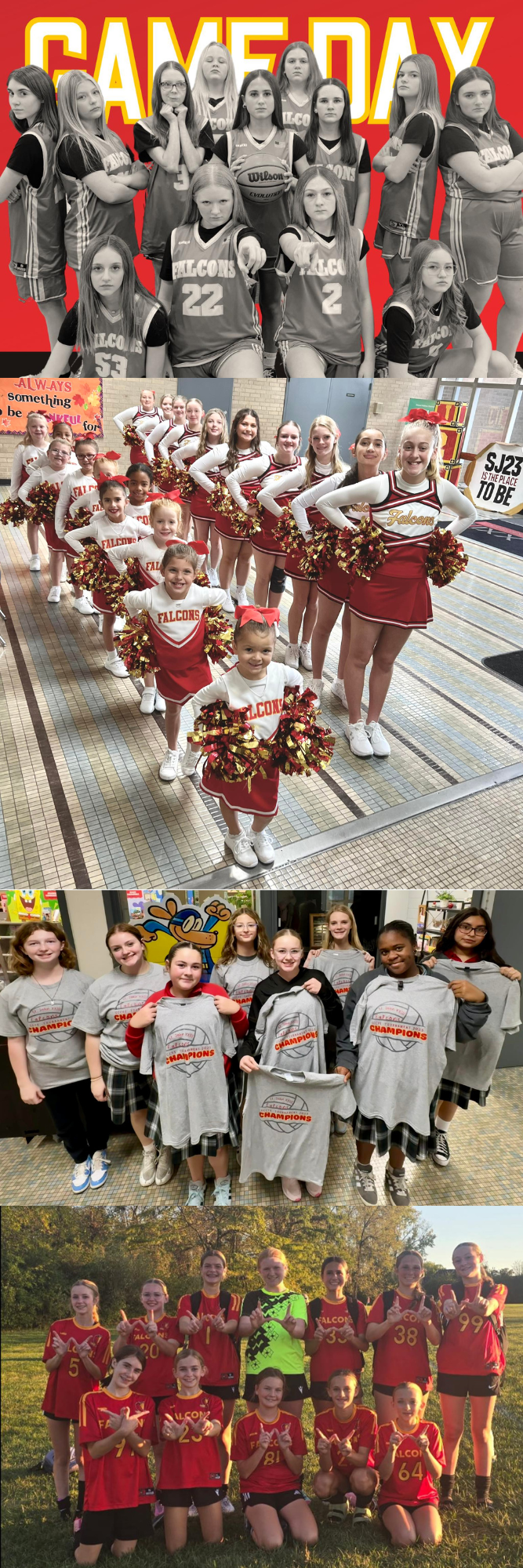
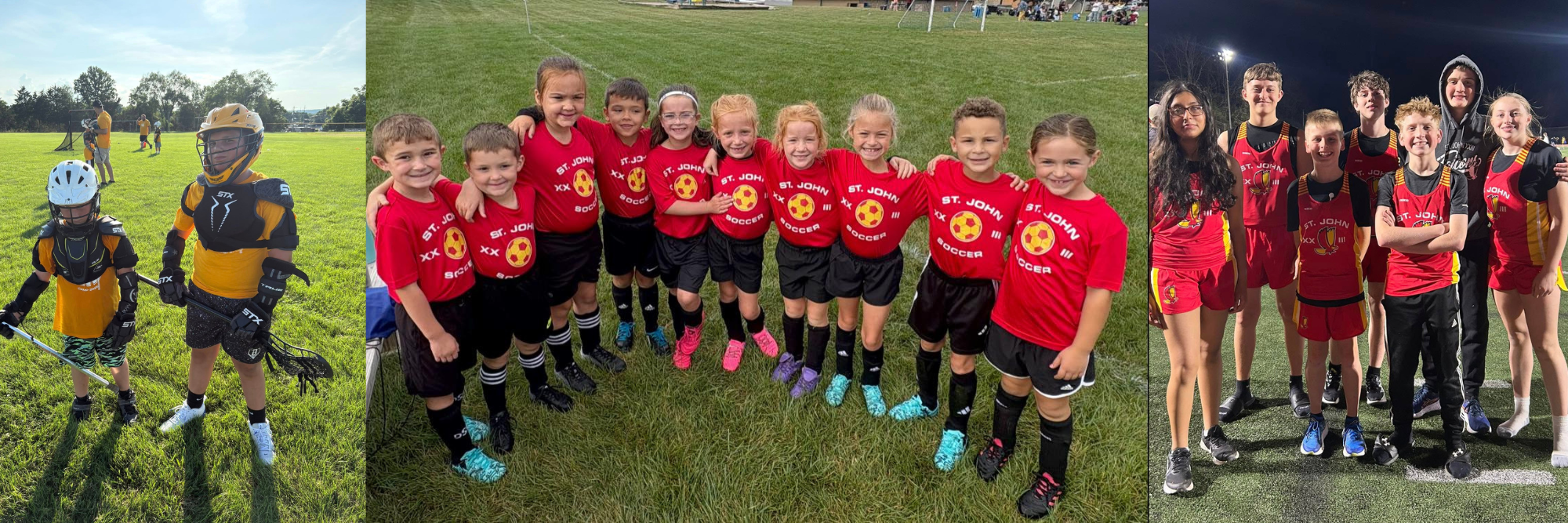
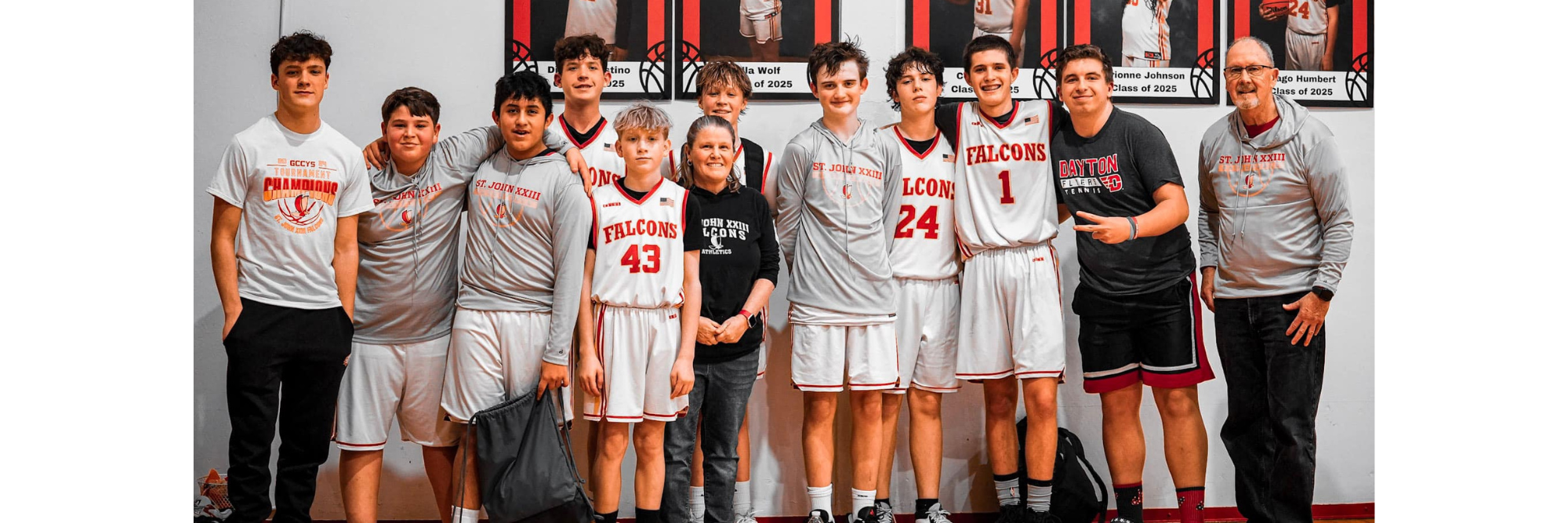
Athletics play a vital role in the development of youth. The school has a 17-acre campus on Manchester Road with a host of amenities not typical of other pre-k through eighth grade schools. The sizeable campus includes a high school regulation-sized football field and gymnasium, and this and other sports facilities provide St. John XXIII an exceptional athletic program.
St. John XXIII provides participation opportunities through the various sports teams:
Boys and Girls Soccer – Grades 4-8
Boys and Girls Basketball Grades 3-8
Boys and Girls Track and Field Grades K-8
Boys and Girls Golf Grades 4-8
Boys Football – Grades K-8
Girls Cheerleading- Grades K-8
Girls Volleyball- Grades 3-8
Boys Volleyball (Spring) Grades 3-8
Boys and Girls Lacrosse- Grades K-8 (Run by the Falcon Lacrosse Club)
All of our sports teams, except Lacrosse, are governed by the St. John XXIII Athletic Board and are held to the same high standards of St. John XXIII Catholic school programs.
Handbook for St. John XXIII Catholic School Athletic Programs
Athletic Policies
Playing Time Understandment
Playing time is subject to league rules.
Eligibility Policy
It is the purpose of the school to prepare students spiritually and academically for the future. A child’s courteous behavior as well as his/her efforts to maintain a “C” average are considered extremely important to his/her character formation and growth in self-discipline. We ask parents and coaches to discuss the following eligibility policy with their children and support our effort to help these young men and women learn to accept the consequences of their actions and mature into responsible citizens.
To be eligible to participate in extracurricular activities students in grades 5 – 8 must maintain a 2.0 overall grade average and exhibit acceptable behavior at school. All subjects on the report card are included in the overall grade average.
- Out of school suspension automatically results in two weeks of ineligibility effective the first day of suspension. The principal may, at his/her discretion, declare a student ineligible based on that student’s behavior at school. The length of the ineligibility period may be determined by the principal according to the circumstances considered.
- The grades and behavior of all participants in extracurricular activities are evaluated for eligibility at interim and report card time (approximately every 4 – 5 weeks.)
- If a student becomes ineligible (either because of grades or behavior) his/her grades or behavior are then evaluated approximately every two (2) weeks. This gives the student every opportunity to improve and become eligible sooner.
- Ineligibility results in the child being unable to practice with the group, or participate in any games, competitions, meetings, projects or other scheduled activities during the ineligibility period.
- Coaches/sponsors are notified at two (2) week intervals of a child’s renewed eligibility.
- Students and parents are notified by the school.
- In order to participate in that day’s athletic event, a student must be present at school the day of the game. Students arriving after 9:00 a.m. on game day, or leaving early on game day may not participate in that day’s activity. This policy includes cheerleaders as well as players.
A student who is either expelled from St. John XXIII or withdrawn in lieu of expulsion will not be eligible to participate in any extracurricular activity sponsored by St. John XXIII Athletic Board.
Refund Policy
I understand that when registering a player there will be no refunds issued once registration is closed. I understand that if my student becomes ineligible due grades or behavior at school, a refund will NOT be issued. I understand that if my child chooses to quit after team placement, I will not receive a refund and the child will not be allowed to register for future seasons.
Uniform Policy
I understand that the athletic uniform(s) that will be used are owned by the school and if not returned at the end of the season and a date set by St. John XXIII Athletics I will be billed $75.00. If uniform(s) are damaged there will be a $75.00 fee as well.
Concussion Release
If an athlete exhibits any signs, symptoms, or behaviors that make you suspicious that he or she may have had a concussion, that athlete must be removed from all physical activity, including sports and recreation. Continuing to participate in physical activity after a concussion can lead to worsening concussion symptoms, increased risk for further injury, and even death. Parents and coaches are not expected to be able to diagnose a concussion. That is the role of an appropriate health-care professional. However, everyone involved in athletics must be aware of the signs, symptoms and behaviors associated with a concussion. If you suspect that an athlete may have a concussion, then he or she must be immediately removed from all physical activity. Signs Observed by Coaching Staff Appears dazed or stunned Is confused about assignment or position Forgets an instruction Is unsure of game, score or opponent Moves clumsily Answers questions slowly Loses consciousness (even briefly) Shows mood, behavior or personality changes Can’t recall events prior to hit or fall Can’t recall events after hit or fall Symptoms Reported by Athlete Headaches or pressure in head Nausea or vomiting Balance problems or dizziness Double or blurry vision Sensitivity to light Sensitivity to noise Feeling sluggish, hazy, foggy or groggy Concentration or memory problems Confusion Does not feel right or is feeling down When in doubt, sit them out! When you suspect that a player has a concussion, follow the Heads Up 4-step Action Plan. Remove the athlete from play. Ensure that the athlete is evaluated by an appropriate health-care professional. Inform the athlete’s parents or guardians about the possible concussion and give them information on concussion. Keep the athlete out of play the day of the injury and until an appropriate health-care professional says he or she is symptom-free and gives the okay to return to activity. The signs, symptoms, and behaviors associated with a concussion are not always apparent immediately after a bump, blow, or jolt to the head or body and may develop over a few hours or longer. An athlete should be closely watched following a suspected concussion and should never be left alone. Athletes must know that they should never try to tough out a suspected concussion. Teammates, parents and coaches should never encourage an athlete to play through the symptoms of a concussion. In addition, there should never be an attribution of bravery to athletes who do play despite having concussion signs and/or symptoms. The risks of such behavior must be emphasized to all members of the team, as well as coaches and parents. If an athlete returns to activity before being fully healed from an initial concussion, the athlete is at greater risk for a repeat concussion. A repeat concussion that occurs before the brain has a chance to recover from the first can slow recovery or increase the chance for long-term problems. In rare cases, a repeat concussion can result in severe swelling and bleeding in the brain that can be fatal. What to do in an Emergency Although rare, there are some situations where you will need to call 911 and activate the Emergency Medical System (EMS). The following circumstances are medical emergencies: 1. Any time an athlete has a loss of consciousness of any duration. While loss of consciousness is not required for a concussion to occur, it may indicate more serious brain injury. 2. If an athlete exhibits any of the following: decreasing level of consciousness, looks very drowsy or cannot be awakened, if there is difficulty getting his or her attention, irregularity in breathing, severe or worsening headaches, persistent vomiting, or any seizures. Cognitive Rest A concussion can interfere with school, work, sleep and social interactions. Many athletes who have a concussion will have difficulty in school with short- and long-term memory, concentration and organization. These problems typically last no longer than 2 -3 weeks, but for some these difficulties may last for months. It is best to lessen the student’s class load early on after the injury. Most students with concussion recover fully. However, returning to sports and other regular activities too quickly can prolong the recovery. The first step in recovering from a concussion is rest. Rest is essential to help the brain heal. Students with a concussion need rest from physical and mental activities that require concentration and attention as these activities may worsen symptoms and delay recovery. Exposure to loud noises, bright lights, computers, video games, television and phones (including texting) all may worsen the symptoms of concussion. As the symptoms lessen, increased use of computers, phone, video games, etc., may be allowed, as well as a gradual progression back to full academic work. Return to Learn Following a concussion, many athletes will have difficulty in school. These problems may last from days to months and often involve difficulties with short- and long-term memory, concentration, and organization. In many cases, it is best to lessen the student’s class load early on after the injury. This may include staying home from school for a few days, followed by a lightened schedule for a few days, or longer, if necessary. Decreasing the stress on the brain early on after a concussion may lessen symptoms and shorten the recovery time. Return to Play After suffering a concussion, no athlete should return to play or practice on that same day. In the past, athletes were allowed to return to play if their symptoms resolved within 15 minutes of the injury. Studies have shown us that the young brain does not recover quickly enough for an athlete to return to activity in such a short time. An athlete should never be allowed to resume physical activity following a concussion until he or she is symptom free and given the approval to resume physical activity by an appropriate health-care professional. Once an athlete no longer has signs, symptoms, or behaviors of a concussion and is cleared to return to activity by an appropriate health-care professional, he or she should proceed in a step-wise fashion to allow the brain to readjust to exercise. In most cases, the athlete will progress one step each day. The return to activity program schedule may proceed as below, following medical clearance: Progressive Physical Activity Program (under supervision) Step 1: Light aerobic exercise- 5 to 10 minutes on an exercise bike or light jog; no weight lifting, resistance training, or any other exercises. Step 2: Moderate aerobic exercise- 15 to 20 minutes of running at moderate intensity in the gym or on the field without a helmet or other equipment. Step 3: Non-contact training drills in full uniform. May begin weight lifting, resistance training and other exercises. Step 4: Full contact practice or training. Step 5: Full game play. If symptoms of a concussion reoccur, or if concussion signs and/or behaviors are observed at any time during the return-to-activity program, the athlete must discontinue all activity and be re-evaluated by his or her health-care provider. Suggested Concussion Management 1. No athlete should return to play (RTP) or practice on the same day of a concussion. 2. Any athlete suspected of having a concussion should be evaluated by an appropriate health-care professional that day. 3. Any athlete with a concussion should be medically cleared by an appropriate health-care professional prior to resuming participation in any practice or competition. 4. After medical clearance, RTP should follow a step-wise protocol with provisions for delayed RTP based upon return of any signs or symptoms.
ARCHDIOCESE OF CINCINNATI PERMISSION, RELEASE AND AUTHORIZATION TO SEEK MEDICAL TREATMENT (rev. 06-2020)
1.I, the parent or lawful guardian of the student that I am registering (the “Child”), give permission for my Child to participate in the activity described on the Activity Information form (the “Activity”) and release from all liability and indemnify Holy Family Parish and St. John XXIII Catholic School (“School”), the Archdiocese of Cincinnati (the “Archdiocese”), the Archbishop of Cincinnati (the “Archbishop”), both individually and as trustee for the Archdiocese, and all parishes and schools within the Archdiocese, their respective officers, agents, representatives, volunteers, and employees, and all priest, bishops, clergy, and religious of the foregoing entities, from any and all liability, claims, judgments, damages, costs and expenses, including attorneys’ fees, arising out of any injury, death, illness, or infectious disease, such as MRSA, influenza, or COVID-19, (including any injury, death, illness, or infectious disease caused by the negligence of School, the Archbishop, the Archdiocese, any parish or school within the Archdiocese, and/or their respective officers, agents, representatives, volunteers or employees) incurred by my child while participating in or traveling to or from the Activity and further agree not to bring or prosecute or allow to be brought or prosecuted (including but not limited to prosecution through subrogation) in my name, or on behalf of my Child, any claims, lawsuits, or actions against School, the Archbishop, the Archdiocese, all parishes and schools within the Archdiocese, and their respective officers, agents, representatives, volunteers and employees. 2. I further understand that my Child’s participation in the Activity is purely voluntary and is a privilege and not a right, and that my Child, and I on behalf of my Child, agree to my Child’s participation in the Activity in spite of the risks. 3. I agree to instruct my Child to cooperate with the Archbishop or his agents in charge of the activity. 4. I appoint the Archbishop or his agents who are acting as leaders of the Activity to seek medical treatment of my Child in the event any injury, illness, infectious disease, or medical emergency occurs during the Activity or related travel. I understand that the agents of the Archbishop will make a reasonable attempt to contact me as soon as possible in the event of a medical emergency involving my Child. 5. I agree that the Archbishop or his agents may use my Child’s portrait or photograph for promotional purposes, website, and office functions and use social media and technology to communicate to my Child regarding ministry related activities. 6. This acknowledgement and release is intended to be as broad and inclusive as permitted by the law of the State of Ohio, and if any portion hereof is declared invalid, it is agreed that the balance shall, notwithstanding, continue in full legal force and effect. This acknowledgement and release shall be construed in accordance with the laws of the State of Ohio, except for the choice of law provisions thereof. 7. School, the Archdiocese, the Archbishop and their agents, employees, and volunteers shall have no liability whatsoever in the event the Activity is cancelled due, in whole or in part, to any present or future pandemic, epidemic, widespread disease or illness, public health concern, or circumstances arising therefrom, or from actions taken by any governmental or municipal authority to prevent, avoid, or mitigate the impacts thereof, irrespective of whether formally declared as a “pandemic”, “epidemic”, or the like by any public health entity or governing body. I have carefully read and understand and accept the terms and conditions stated herein and acknowledge that this Permission, Release and Authorization to Seek Medical Treatment shall be effective and binding upon me, my Child, and my own and my Child’s personal representative or estate, assigns, heirs, and next of kin and that I have signed this agreement of my own free will.
Lindsay’s Law
Please click the Lindsay’s Law Video and Waver link to the left to go to the video along with reading the following information below about Sudden Cardiac Arrest. What is Lindsay’s Law? Lindsay’s Law is about Sudden Cardiac Arrest (SCA) in youth athletes. It covers all athletes 19 years or younger who practice for or compete in athletic activities. Activities may be organized by a school or youth sports organization. Which youth athletic activities are included in Lindsay’s law? -Athletics at all schools in Ohio (public and non-public) -Any athletic contest or competition sponsored by or associated with a school -All interscholastic athletics, including all practices, interschool practices and scrimmages -All youth sports organizations -All cheerleading and club sports, including noncompetitive cheerleading What is SCA? SCA is when the heart stops beating suddenly and unexpectedly. This cuts off blood flow to the brain and other vital organs. People with SCA will die if not treated immediately. SCA can be caused by 1) a structural issue with the heart, OR 2) an heart electrical problem which controls the heartbeat, OR 3) a situation such as a person who is hit in the chest or a gets a heart infection. What is a warning sign for SCA? If a family member died suddenly before age 50, or a family member has cardiomyopathy, long QT syndrome, Marfan syndrome or other rhythm problems of the heart. What symptoms are a warning sign of SCA? A young athlete may have these things with exercise: -Chest pain/discomfort -Unexplained fainting/near fainting or dizziness -Unexplained tiredness, shortness of breath or difficulty breathing -Unusually fast or racing heart beats What happens if an athlete experiences syncope or fainting before, during or after a practice, scrimmage, or competitive play? The coach MUST remove the youth athlete from activity immediately. The youth athlete MUST be seen and cleared by a health care provider before returning to activity. This written clearance must be shared with a school or sports official. What happens if an athlete experiences any other warning signs of SCA? The youth athlete should be seen by a health care professional. Who can evaluate and clear youth athletes? A physician (MD or DO), a certified nurse practitioner, a clinical nurse specialist, certified nurse midwife. For school athletes, a physician’s assistant or licensed athletic trainer may also clear a student. That person may refer the youth to another health care provider for further evaluation. What is needed for the youth athlete to return to the activity? There must be clearance from the health care provider in writing. This must be given to the coach and school or sports official before return to activity. All youth athletes and their parents/guardians must review information about Sudden Cardiac Arrest, and agree to this waver.
St. John XXIII/GCCYS Code of Conduct
I agree that all players, coaches and spectators are reminded that their participation in a sporting event is a form of representation of St. John XXIII Catholic School. Certain behaviors from players, coaches and spectators will not be tolerated and could result in expulsion from the program. In particular, participants in practices or sporting events shall refrain from the following behaviors; -Inappropriate language and actions, including any combination of interaction between players, coaches, referees or audience members. -Acts of violence, verbal threats of violence or body gestures inferring violence. -Verbal abuse such as insults -Use of tobacco and alcohol -Refusal to congratulate the opposing team after each contest. Violation of any of the above will result in suspension or expulsion from the athletic program. The St. John XXIII Catholic School principal, with consultation from the athletic board, will determine the appropriate action. The Principal or the Board does not have any authority over the actions of officials during the action of the game. If an official chooses to dismiss a player, coach or spectator from a game due to perceived negative behavior, that player, coach or spectator must abide by the decision. The Board, at the request of the league or the player, coach or spectator, may investigate the matter and determine whether further action is appropriate. A player, coach, parent, or fan who is ejected from an athletic contest for any reason whatsoever must immediately leave the premises (including the field of play, stands, and adjacent areas such as nearby parking lots) and shall be suspended and unable to attend the next scheduled athletic contest. If a coach, parent, or fan is ejected from an athletic contest for any reason, the youth player associated with that individual, without regard to whether or not the ejected individual is a parent of the associated player, cannot continue playing in the game and will be ejected from the athletic contest and must leave the premises. The associated youth player also may not participate in the next scheduled athletic contest. GCCYS CODE OF CONDUCT Greater Cincinnati Catholic Youth Sports adheres to and has adopted as its own the Code of Conduct that is published in the Archdiocese of Cincinnati Charter on Youth Athletics. Each youth participant, parent, coach, volunteer or fan is expected to adhere to the requirements of the Code of Conduct, which is printed in Section I below. The GCCYS has adopted the Disciplinary Action Policy as described in this document to deal with violations of the Code of Conduct. These policies have been adopted by the GCCYS to ensure the safety of participants, coaches, referees, parents and fans while participating in GCCYS sponsored activities, and will be strictly enforced. I. Code of Conduct (as adopted from the Archdiocese of Cincinnati Charter on Youth Athletics). 1. Introduction All who are involved in the GCCYS are expected to conduct themselves as examples of Christian behavior. This is essential and expected as a witness to the mission of the ministry of GCCYS, both on the court of play and away from it. The conduct of coaches and players in competitions has a powerful impact on the conduct of parents and fans, the love of the sport, and the reputation of the Catholic faith community. This Code of Conduct extends to all events or activities sanctioned or sponsored by the GCCYS; including but not limited to meetings, games, attendance at another team’s game, camps, players’ clinics, officials’ clinics, and during other related activities. Any player, coach, parent or fan in violation of this Code of Conduct will be subject to disciplinary action without warning as described within this document in the Disciplinary Action Policy. 2. Spirit of Catholic Youth Athletics. • Treat everyone with respect and love according to the Great Commandments: “You shall love the Lord, your God, with all your heart, with all your soul, and with all your mind. This is the greatest and the first commandment. The second is like it: You shall love your neighbor as yourself. The whole law and the prophets depend on these two commandments.” Matt.22:37-40 • Demonstrate good sportsmanship, patience, manners and an attitude indicative of the spirit and mission of the Catholic Church. 3. Adherence to Laws, Rules and Policies. • Catholic canon law and Archdiocesan laws and policies including, but not limited to, the Archdiocese of Cincinnati Decree on Child Protection. • Federal, state, and local laws and ordinances. • The mission, goals, principles, and policies of the Archdiocese of Cincinnati Charter on Catholic Youth Athletics, and those of the GCCYS. 4. Specific Violations. • Eligibility: Violation of the eligibility policies of the Archdiocese of Cincinnati Catholic Youth Athletics Charter, including using an ineligible player. • Recruiting: No recruiting for athletic purposes or to enhance a team’s competitive advantage is permitted. • Leaving the field of play: No team may leave the field, floor, game or tournament because of dissatisfaction with the officials, or their decisions. • Losing control: Coaches are expected to control their own conduct and the conduct of their players and report to the league and Commission instances where opponents, officials, parents, or fans have failed to control their own conduct. • Running up the score: It is not permitted to humiliate an opposing team by playing in such a way so as to intentionally run up the score after the outcome of the game is no longer in question. • Inappropriate communication and behavior: The use of inappropriate, insulting, disrespectful, bullying and demeaning language or behavior before, during or after meetings, practices or games by players, coaches, officials, parents, fans, site personnel, volunteers, or others involved in any GCCYS and/or Athletics programs involved in the GCCYS is prohibited. Also prohibited are physical intimidation and the use of profane, vulgar, abusive or sexually oriented language, in oral, written or electronic forms of communication (such as texting or email), by players, coaches, officials, parents, site personnel, volunteers, or fans. • Escalating behaviors: Behaviors that incite others to act in ways that are in direct conflict with the spirit of Catholic Youth Athletics are prohibited. • Vandalism and theft: There will be no vandalism, theft, or destruction of property at any athletics venue. • Alcohol, tobacco, illegal controlled substances: No alcohol, tobacco, or any illegal controlled substance is permitted at practices, league competitions, or tournaments where children are present (such as “tailgating” where alcohol is present). Athletics organizations are expected to establish and communicate zero tolerance policies regarding alcohol, tobacco, and illegal controlled substances at competitions, tournaments and gatherings where children are present. • Activities that are contrary to the mission, goals, principles, values, provisions or spirit of Catholic Youth Athletics as described in this Code of Conduct are prohibited. II. Disciplinary Action Policy. 1. Sanctions for Non-Compliance with the Code of Conduct. All participants, including players, coaches, parents and fans are reminded that the GCCYS is a volunteer-run organization that strives to provide a safe environment for our student-athletes to compete with and against their friends with shared Catholic Christian values and in compliance with the Archdiocese of Cincinnati Charter on Youth Athletics. In the unfortunate event that a player, parent, or fan does not model appropriate Catholic Christian behavior while participating in or attending a GCCYS sponsored event, or otherwise violates the Code of Conduct, the following disciplinary actions may be exercised against the player, parent, and/or fan exhibiting such behavior. In the case of a violation of this Code of Conduct, a warning is not required to be provided to the individual by a coach, game official, or authorized leader or parish representative before disciplinary actions are taken. Any such individual may be ejected and suspended from GCCYS sponsored activities without warning as follows: a. Ejection: • A player, coach, parent, or fan who is ejected from an athletic contest for any reason whatsoever must immediately leave the premises (including the field of play, stands, and adjacent areas such as nearby parking lots) and shall be suspended and unable to attend the next scheduled GCCYS sponsored league athletic contest. • If a coach, parent, or fan is ejected from an athletic contest for any reason, the youth player associated with that individual, without regard to whether or not the ejected individual is a parent of the associated player, cannot continue playing in the game and will be ejected from the athletic contest and must leave the premises. The associated youth player also may not participate in the next scheduled GCCYS sponsored league athletic contest. • If a player is removed from an athletic contest due to accumulating fouls or other infraction covered by game rules (i.e. 5 fouls in a basketball game), that player is not required to leave the premises. b. Suspension: • As indicated above, any individual who is ejected from a GCCYS sponsored athletic contest shall be prohibited from attending the next game. Additional suspensions may be issued for egregious violations of the Code of Conduct and may include multiple games, practices, and other team activities at the sole discretion of the GCCYS. • If an individual or associated youth player fails to adhere to the terms of any one-game suspension, violates the terms of an additional suspension or commits a subsequent violation of the Code of Conduct, then additional sanctions shall be imposed by the GCCYS, as follows: Violation When/Where Occurred Sanction First Before, during, or after a game or practice Ejection for the rest of the game or practice; attendance at next game prohibited. Second Before, during, or after a game or practice Ejection for the rest of game or practice; attendance at next two games prohibited. Third Before, during, or after a game or practice Attendance at practices, games and any other team activities is prohibited for the rest of the season. c. Appeal: • There is no opportunity for any individual who is subject to the terms of this Disciplinary Action Policy to appeal any Ejection or automatic one-game Suspension issued for violations of this Code of Conduct. Sanctions and discipline for serious violations of the Code of Conduct will be handled on an individual basis by the GCCYS.
COVID-19
Acknowledgement of Risks We, the parent(s) and student, acknowledge and agree that, as a student at St. John XXIII Catholic School and Holy Family Parish and as parent(s) of that student, entering in the school or being on the premises, having personal contact with teachers, classmates, and other St. John XXIII Catholic School and Holy Family Parish staff, involves a certain degree of risk, namely of parent(s) and/or student acquiring a communicable disease, including COVID-19, and then potentially passing it on to others, including family members. Due to the highly contagious nature of COVID-19, the characteristics of the virus, and the close proximity of students, teachers, and staff at St. John XXIII Catholic School and Holy Family Parish, there is an elevated risk of student contracting the disease simply by being in the building, on the premises, or at any St. John XXIII Catholic School and Holy Family Parish function. The same is true for parent(s) of a student at St. John XXIII Catholic School and Holy Family Parish. By signing this Handbook below, we acknowledge and agree that after carefully considering the risks involved, and having the opportunity to discuss these risks with any healthcare professional(s) of our choosing, we voluntarily and willingly accept those risks and acknowledge that returning to in-person classes and other in-person St. John XXIII Catholic School and Holy Family Parish functions is the choice of each family, including ours. If student or parent(s) who visit St. John XXIII Catholic School and Holy Family Parish have underlying health concerns which may place them at greater risk of contracting any communicable disease, including COVID19, we acknowledge and agree that we will consult with a health care professional before student or parent(s) return to St. John XXIII Catholic School and Holy Family Parish, attend any St. John XXIII Catholic School and Holy Family Parish function, or visit St. John XXIII Catholic School and Holy Family Parish. Moreover, we acknowledge that while adherence to safety and precautionary measures (e.g., social distancing guidelines, facemasks, handwashing, etc.) may reduce possible exposure to the risk of contracting a communicable disease, the possibility of serious illness and death remains. We do hereby accept and assume sole responsibility for any illness acquired by student or parent(s) while at St. John XXIII Catholic School and Holy Family Parish or any St. John XXIII Catholic School and Holy Family Parish function, including possible infection with COVID-19. We further acknowledge, understand, and agree that we have obligations to St. John XXIII Catholic School and Holy Family Parish, its faculty, students, and others to take certain precautions and make certain disclosures to prevent the spread of COVID-19. Specifically, we agree that neither student nor parent(s) will come to St. John XXIII Catholic School and Holy Family Parish or attend any St. John XXIII Catholic School and Holy Family Parish function in person, if in the 14 days prior to coming to St. John XXIII Catholic School and Holy Family Parish or any St. John XXIII Catholic School and Holy Family Parish function, student or parent(s) has had any of the following: new cough, shortness of breath, difficulty breathing, fever of 100.4 °F or higher (intermittent or constant), chills, new muscle pains or body aches, headache, sore throat, congestion or runny nose, new loss of taste or smell, or gastrointestinal symptoms like nausea, vomiting, or diarrhea. This does not apply if these symptoms have been affirmatively diagnosed by a healthcare provider as being caused by some non-contagious illness or condition. In such case, we agree to obtain supporting documentation from our healthcare provider and share such documentation with St. John XXIII Catholic School and Holy Family Parish. Additionally, we agree that neither student nor parent(s) will come to St. John XXIII Catholic School and Holy Family Parish or any St. John XXIII Catholic School and Holy Family Parish function if in the last 14 days, student or parent(s) has had prolonged (more than 10 minutes) close contact (within 6 feet) with anyone, including a family member, diagnosed with or suspected of having COVID-19.